National Newt Day
News
BSU celebrates National Newt Day 2026
Friday, 24 April, 2026In 2024, Bath Spa University established the world’s first National Newt Day. Taking place on 24 April each year, National Newt Day brings attention to providing and protecting habitats for Great Crested newts and other newts living in the UK.
BSU’s Newton Park campus is home to all the UK’s native newt species: Smooth, Palmate and, most notably, the Great Crested newt. As spring temperatures get warmer, BSU’s resident newts begin moving to ponds for the breeding season, and Newton Park becomes a living lab where students can take advantage of the natural ecosystem to survey and monitor wildlife.
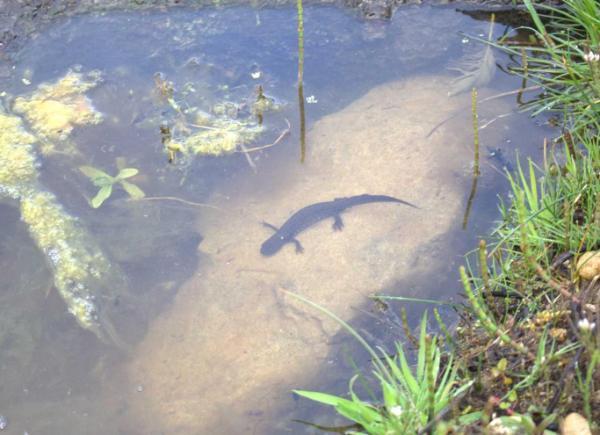
Surveys are carried out every year, giving a snapshot of BSU’s newt populations to check that everything is going well. This year, there will be a snapshot survey when temperatures are warm enough. Because the newts are most active at night, in the evening after dark torches are used to search for newts in the ponds and bottle traps – funnels that newts swim into and can't get out of until they are released – are set. In the morning, the bottle traps are checked and any newts in them are recorded according to species and sex.
Finally, the plants in the ponds in the Walled Garden, the Italian Garden and next to the playing field are checked for eggs. Female newts lay their eggs on leaves that they then fold around the egg to protect it.
Dr Ralph Thompson, Senior Lecturer in Zoology and Programme Leader for BSc Willdlife Conservation, explained:
“The eggs will hatch into aquatic larvae that live in the ponds until they have eaten enough to undergo metamorphosis into efts – small juvenile terrestrial newts – that will leave the ponds to live on land. These efts will take two to four years to become adults and be ready to return to the ponds to mate.”
BSU’s Grounds team also plays an important role in supporting the University’s newt population by maintaining their habitats and getting the ponds and surrounding areas ready for them as the breeding season approaches.
This year, exclusion fencing has been put up around university buildings in preparation for planned works later in the year. At intervals along the inside of the fencing, small buckets are buried at ground level to capture any newts as they move around the site.
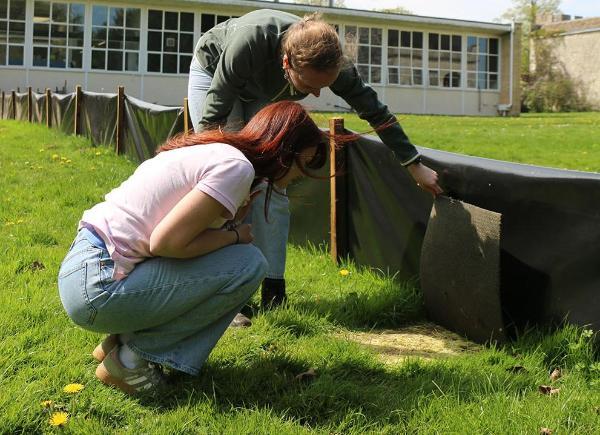
Ecologists from Nicholas Pearson Associates, including BSU students working as assistant ecologists, have been coming in daily to check the bucket traps for any animals that may have wandered in and release them into suitable habitat outside of the fenceline. At the end of 30 days, if there has been a period of five days without capture of a Great Crested Newt, the ecologists will observe as the Grounds team conducts a careful search and destruction of the habitat to see if there are any newts and relocate them to a safer place.
Grounds Team Manager Penny Snowden said:
“Despite all the hard work required to look after the newts, it is good to know that our campus provides habitat for them, and lovely to see the first eggs laid every year.”
Are you passionate about protecting wildlife and their habitats? Check out our life sciences courses. You can also keep up with our amazing Grounds team on Instagram.