Imaginaries and Infrastructures
Imaginaries and Infrastructures collects scholars and creatives from across the School of Art, Film and Media and beyond to explore the ideas that govern our lives and to create new liberatory perspectives.
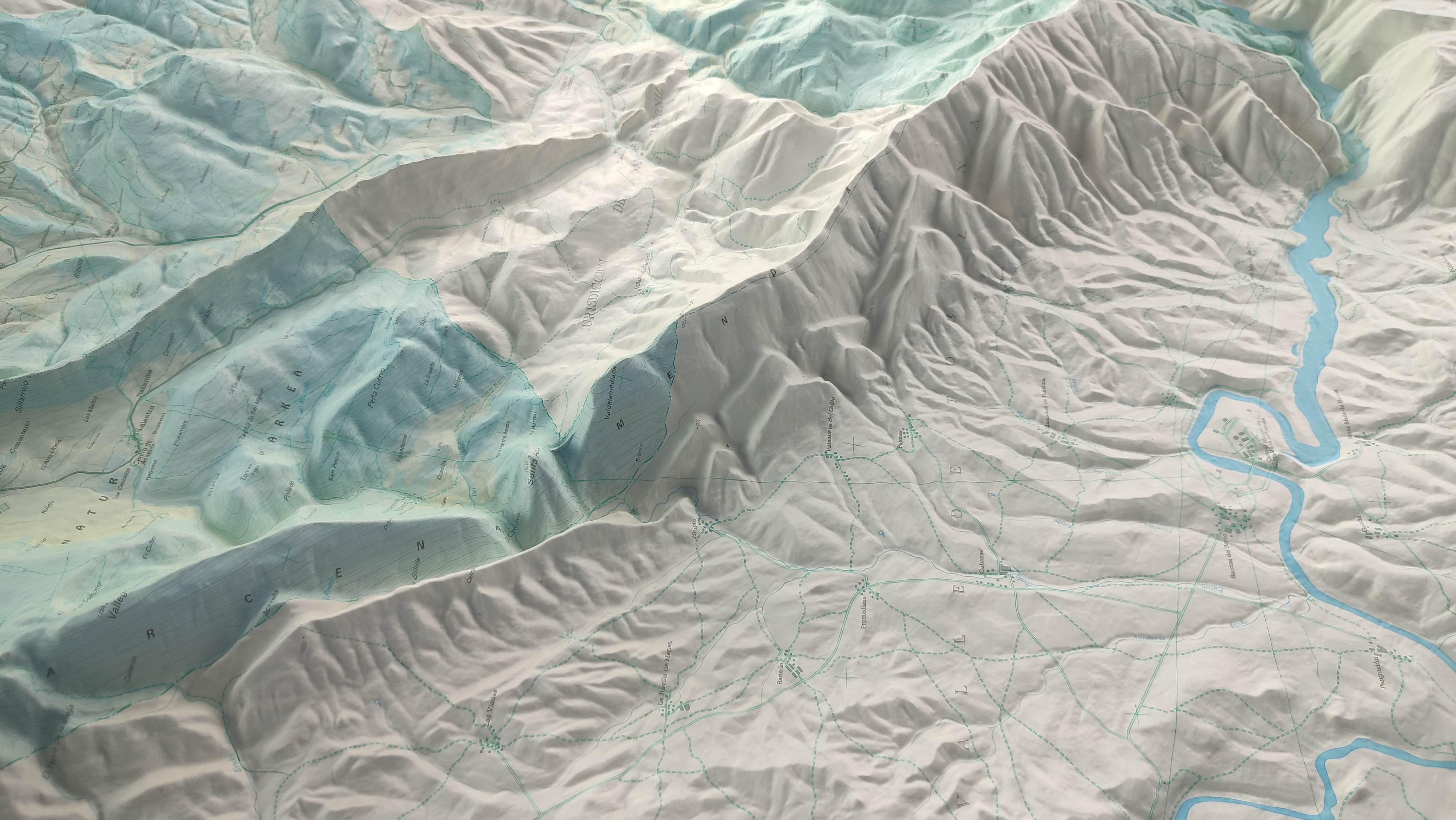
Image credit: The River and its Places, video-frame, Belén Cerezo.
Our purpose
Imaginaries and Infrastructures is a research network whose nucleus may begin at Bath Spa University, but whose overall scope aims to expand far beyond its host institution. The imaginaries and infrastructures it explores can be best summarised as the creative processes by which the world is articulated.
That might be through creative practices of art, media-making, “fictioning”, and speculation as means by which to envision different worlds. Equally, we might be concerned with the imaginaries that structure and pre-condition the capacity to experience, think, and act. These imaginaries are supported by and activated within infrastructure.
Infrastructure names concrete things in the world: sewers, data centres, the energy grid, as well as policies, protocols, and code that serve as the administrative infrastructure of daily life. However, the notion of infrastructure can also provide a framework of analysis of more abstract but no less real infrastructures of thought: the concept, discourse, epistemology.
This network enables researchers to collectively explore each of these concepts, forming art, theory and other interventions that provide insight into the historical, current and future states of thought and reality: the structures that have formed us, the infrastructure that surrounds us, the imaginaries that free us. It is a critical project concerned with power and political contestation of what is possible at any given historical conjuncture.
The network’s name is a reminder that imagining does not happen in a vacuum; infrastructures do not materialize from nowhere. The two are inseparable: imaginaries are enacted through the affordances of infrastructure.
More practically, while this research network questions the nature of current ideas and structures, it is also an experiment in building an infrastructure for thinking and doing together as a research community, an imaginary of new forms of the academy. This network cuts across the institutional context of research and extends the affiliation and resources beyond and outside our host university.
Taking inspiration from Harney and Moten’s notion of the undercommons, this network is an active imagining of a mode of transdisciplinary, collective research practice that extends the benefits institutional infrastructure provides: concretely—funding opportunities, space— and other intangible (yet powerful) resources—"legitimacy”, “clout”, or “authority”. In this way, it physically manifests the imaginary infrastructures that we hope to inspire.
Members from other institutions
Dr Belén Cerezo
Dr Belén Cerezo is an artist-researcher. Since 2025 she has worked as a Lecturer in the Media Department in the University of Burgos, Spain.
From 2022 to 2024, she was a postdoctoral researcher at the Faculty of Fine art at the University of the Basque Country EHU, Bilbao. She completed her practice-led PhD at Nottingham Trent University (2015).
Her research examines the functioning of images and attends to the transition from a representational model to a performative one that explores new forms of action, relationship and practice generated by images. Cerezo makes moving-image installations, videos, and photographs.
Zhenia Vasiliev
Zhenia is an academic working in STS, critical administration, and software studies, developing interdisciplinary methods for studying software. Trained in art and design, they completed a PhD at Goldsmiths.
Zhenia has curated events, worked in design and software production, and created collective performance artworks in the UK and abroad.
María/Rosario Montero
María/Rosario Montero is a feminist artist-researcher whose work explores how power shapes representations of nature, landscape, identity, and territory through visual arts and cultural theory.
Her current affiliation is with Universidad Finis Terrae, Faculty of Arts, where she serves as an academic and researcher. Based in Santiago, Chile, she is also a member of the art collective Agencia de Borde.
Nicole Sansone Ruiz
Nicole Sansone Ruiz is Senior Research Associate at the Edmund W. Gordon Institute for Advanced Study (TC Gordon) at Teachers College, Columbia University. She earned her PhD in Cultural Studies from Goldsmiths, University of London in 2019 and has held consecutive postdoctoral fellowships at UPenn’s School of Social Policy & Practice and TC Gordon.
Her research bridges media theory, cultural studies, and aesthetics, and over the last five years has applied this approach to the topics of right-wing politics in computer graphics, AI governance and ethics, and social policy.
She is currently writing a book on how computational technologies have created a new aesthetics of realism through a study of images of the sky.
You can get real-time updates on her research by following her Instagram account: @theeyerony.
Neda Genova
Neda Genova is Lecturer in Digital Media in the department of Film Studies, University of Southampton. She’s interested in opening spaces for collaborative, experimental publishing practices that traverse disciplinary boundaries in art, activism, and academia.
Neda’s research has appeared in journals such as Time and Society, Journal of Visual Cultures and New Formations. She recently edited the volume Post-Communist Grounds. In Search of the Commons (Amsterdam: Institute of Network Cultures, 2025) while her first monograph, Politics of Surfaces. Transformation of Public Space in Post-Communist Sofia is forthcoming with Goldsmiths Press in October 2025.
Theo Reeves-Evison
Theo Reeves-Evison is a writer, researcher and Senior Lecturer at Birmingham School of Art. From 2018-22 he led the Leverhulme-funded project Speculative Natures, which investigated the critical imbrications of ecology, visual culture, and climate futures, and resulted in several publications and curated events.
He is the co-editor of Fiction as Method (Sternberg, 2017), and has contributed to publications including Third Text, New Formations, Critical Inquiry and Environmental Humanities.
Current projects in development include a second monograph entitled Futures in the Making (MIT Press, 2026) and a collaborative research project on the ‘Political Ecology of Volume’ together with Lydia Cole and Yolande Ariadne Collins.
Members from Bath Spa University
Dr Chris Gerrard
Dr Chris Gerrard is a practitioner-theorist, focusing on how experimental aesthetics can facilitate knowledge exchange and political change. Chris is also Course Leader for Creative Media.
Dr Conrad Moriarty-Cole
Dr Conrad Moriarty-Cole’s research sits at the intersection of cultural studies, media theory, computer science and philosophy, specialising in AI and big data. Conrad is also Course Leader for Media Communications.
Dr Yuhan Wang
Dr Yuhan Wang is a lecturer in Sociology. Her research sits at the intersection of Sociology and Science and Technology Studies (STS). Her research interests include infrastructures, datafication, digital sovereignty, and digital methods. She explores digital infrastructures in both Western and East Asian ecosystems, with a focus on unpacking the ‘black box’ of technology as a way of analysing society.
Get in touch
If you are interested in getting involved with the Imaginaries and Infrastructures group, or have questions, please get in touch with the group's co-leads:
- Dr Chris Gerrard: c.gerrard@bathspa.ac.uk
- Dr Conrad Moriarty-Cole: c.moriarty-cole@bathspa.ac.uk
Image credit: Chris Gerrard, Elements