Criminology and Sociology
BSc (Hons)
Undergraduate degree - combined honours
- UCAS codes: Institution B20, Course D32H or SE74 (with professional placement year)
- Criminology - Programme Document
- Sociology - Programme Document
Investigate, scrutinise and understand the causes, consequences and responses to crime with our Criminology degree at Bath Spa University.
- A programme of study which focuses on criminological, sociological and psychological perspectives of crime.
- Examines crime, justice and punishment at local, national and transnational levels of society.
- A theoretical and applied approach to criminology to develop your knowledge and skills.
Criminology explores the causes, motivations and patterns of crime. In addition to improving our knowledge and understanding of crime, criminology also considers responses to crime and informs policies and practices in policing, law, criminal justice and punishment.
With our Criminology degree, you'll study crime from a variety of approaches, gain practical and relevant experience, and develop transferable skills that you can take into a range of careers and employment sectors.
What you'll learn
Criminologists study crime from a variety of approaches, making this a diverse field of study. Core modules focus on the main theories, debates, issues and research in criminology and criminal justice, while optional modules enable you to develop your particular interests in areas such as violent crime, victimisation, prisons and terrorism.
We’ll support and encourage you to gain practical experience in relevant fields through voluntary work and placements. You’ll develop practical and analytical skills as well as subject knowledge in crime and criminal justice.
At BSU, our courses are designed to equip our graduates with the knowledge and skills they’ll need for the real world. To do this, we are continually improving our courses by responding to feedback from students and other stakeholders. This may mean changes may be made to the curriculum. You’ll always be given notice of any such changes.
For more information on how we approach such changes at the university, please read our policies on
Year one
You’ll learn about the research traditions of criminology and be introduced to key concepts, theories and issues. You’ll investigate different types of crime and you’ll also learn about criminal law and criminal justice agencies and institutions.
Year two
You'll study contemporary debates in criminology and criminal justice and the history and development of policing, crime control and prevention.
You can also choose from a number of optional modules to create a programme tailored to your personal interests. You can investigate the criminological imagination by exploring differing perspectives and theories within criminology. You can also study violent crimes such as homicide and robbery.
Year three
You’ll undertake an original piece of criminological research in an area that interests you and you’ll also be able to examine terrorism, punishment and penology and victimisation with our optional modules. You’ll have the choice to take our optional module in criminology which involves working with prison learners through a partnership with HMP Erlestoke.
There will also be opportunities to undertake a voluntary placement in an organisation relevant to the criminal justice sector with our optional community engagement module.
We use a range of assessments to gain a comprehensive measure of your performance. Assignments may include essays, book reviews, examinations, portfolios, crime scene investigation reports, presentations, design of a non-custodial punishment, reflective writing, briefing papers and individual and group projects.
We take pride in our innovative and engaging modules that inspire and challenge, and we encourage you to reflect critically on your subject.
We’ll guide you through your studies, support you, and help you make the most of your academic studies. Your personal timetable will comprise all the modules for which you have been registered, and these incorporate different modes of teaching.
You’ll participate in a wide variety of activities including lectures, seminars, workshops, one-to-one tutorials, and sessions with visiting speakers.
To find out more about how we teach and how you'll learn, please read our information on Your Learning and Teaching at BSU.
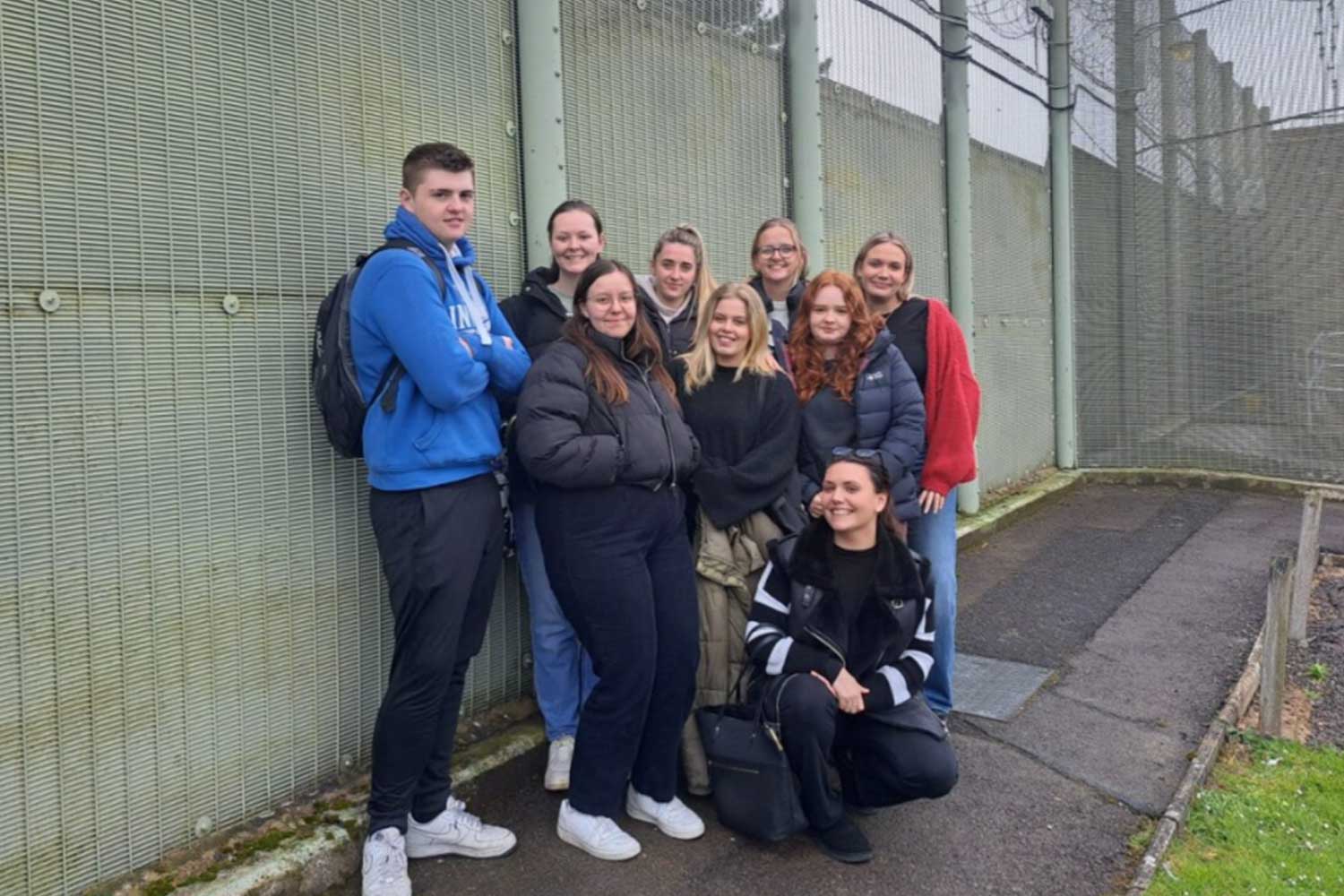
Third-year BSc (Hons) Criminology students visiting HMP Erlestoke as part of a unique module where students learn criminology alongside prison learners.
Opportunities
As part of your degree, you could study abroad on a placement at one of Bath Spa’s partner universities.
We’ll strongly encourage you to take advantage of placement opportunities in your second and third year, so you can apply your learning in the real world contexts of criminal justice. Practitioners contribute to teaching in some modules and you can find out more from them about working in fields related to criminal justice.
Fieldwork opportunities, such as trips to local courts, will also provide opportunities to observe the legal system in action and learn more about potential careers. We also have links with local criminal justice organisations including local police services and prisons.
Project work enables you to focus on your particular interests and is built into all three years of the programme. Through individual and group projects you’ll develop employment-related skills in research, analysis, time management, leadership, problem-solving and planning.
Your first year involves a project with creative, critical and reflective elements.
Moving into your second year, you’ll undertake in-depth study of the spatial dimensions of crime. A module in research methods will give you experience of research design and data collection and analysis to support project work.
In the dissertation core module in your third year, you can apply the knowledge and skills you’ve developed to an independent research project on any criminological or criminal justice topic that interests you.
A qualification in Criminology will prepare you for a career in a variety of relevant fields in criminal justice and associated social and welfare professions including:
- Policing
- Crime prevention and security
- Crime reduction initiatives
- Law (following further study)
- Offender management and interventions
- Prisons
- Probation
- Youth justice
- Social work
- Community development
As a social sciences degree, the course will give you with a range of transferable skills which you can take into a career in a number of others sectors such as health and social care, marketing, HR, teaching or the media.
If you’re a full-time undergraduate student starting your first year at Bath Spa University, you can apply for the Certificate in Global Citizenship, which you’ll study alongside your degree.
You’ll gain global awareness and add an international dimension to your student experience, and funding is available. On successful completion of the programme, you’ll be awarded a Certificate in Global Citizenship. This is in addition to your degree; it doesn’t change your degree title or results.
"The chance to take part in various field trips in the final year was amazing and really solidified all that we learned in the three years preceding the trips. Additionally, a placement year enabled me to secure postgraduate employment ahead of finishing university."
Jasmine Henry, BSc (Hons) Criminology with Professional Placement Year

Professional placement year
The Professional Placement Year (PPY) provides you with the opportunity to identify, apply for, and secure professional experience, normally comprising one to three placements over a minimum of nine months. Successful completion of this module will demonstrate your ability to secure and sustain graduate-level employment.
By completing the module, you'll be entitled to the addition of 'with Professional Placement Year' to your degree title.
Before your PPY, you'll work to identify roles of interest and secure a placement. The Placements Team will support through timetabled sessions and 1:1 appointments.
As well as completing a minimum of 900 placement hours, you will complete two assessments demonstrating your skill development, growth in professional behaviours and how the PPY has impacted your future career aspirations.
Facilities
Criminology is taught at our Newton Park campus.
All modules can be found on our Virtual Learning Environment, Ultra, providing unlimited online access to learning materials such as handbooks, lecture slides, assessment information, discussion boards and other resources.
Our library gives you access to books, academic journals and DVDs and an extensive range of electronic services. It also provides a place for individual study and collaborative work.
Fees
| Student | Annual tuition fee |
|---|---|
| UK full time | £9,790 |
| UK part time | £4,895 |
| International full time | £17,310 |
Professional Placement Year
During the placement year, the fee is reduced to 20% of the full time fee. This applies to UK and EU/International students.
- UK: £1,955
- International: £3,462
International fee information
Our fees for international students are organised into bands. For more information, please consult the tables on the international student fees webpage.
Additional course costs
You may need to pay additional course costs over and above your tuition fees, for example, for specialist equipment or trips and visits. Please check the course Programme Document (linked under the main image on this page) for details of any additional costs. You can also read our Additional Course Costs Policy for further information.
Funding opportunities
Please visit our Funding pages for an overview of the funding options that may be available, including scholarships and bursaries.
Interested in applying?
We’re looking for individuals who are interested in all aspects of crime, justice and punishment.
You’ll be looking to study these issues from varying perspectives including psychological and sociological, that challenges conventional or ‘common sense’ notions of criminality.
We accept a wide range of qualifications for entry to our undergraduate programmes. The main ones are listed below:
- A Level – grades BBB-BCC. No specific subject required.
- BTEC – Extended Diploma grades from Distinction Distinction Merit (DDM) to Distinction Merit Merit (DMM). No specific subject required.
- T Levels – grade Merit. No specific subject required.
- International Baccalaureate – a minimum of 32 points. No specific subject required.
- Access to HE courses – Access to HE Diploma or Access to HE Certificate (60 credits, 45 of which must be Level 3, at Merit or higher). No specific subject required.
If you don’t meet the entry requirements above, we may be able to accept your prior learning or experience from outside of formal education. See our Accreditation of Prior Learning (APL) page to learn more.
English Language Requirements for International and EU Applicants
IELTS 6.0 - for visa nationals, with a minimum score of IELTS 5.5 in each element.
Course enquiries
For further information about the programme or entry requirements, please email us at admissions@bathspa.ac.uk.
Ready to apply? Click the 'apply now' button in the centre of this page. Need more guidance? Head to our how to apply pages.
Programme leader: Dr Isik Akin
Email address: i.akin@bathspa.ac.uk
Three year course
With placement year
Our BSc Sociology degree combines critical theory with real-world practice, giving you the knowledge and skills to understand and respond to the most urgent challenges of our time.
- Practice Sociology in real world contexts with an applied programme that works closely with practitioners, communities, and organisations.
- Gain the skills to apply sociological insight beyond the classroom. Learn through authentic tasks that mirror graduate work, such as reports, policy briefings, digital outputs, and work for external organisations.
- Engage with the most urgent issues shaping contemporary life – from online misogyny and incel culture, to mental health and housing crises, climate change, global conflict, political polarisation, and the social impact of social media, AI and emerging technologies.
At its core, Sociology is the systematic study of how we live, work, and interact within social, economic, cultural, and political contexts. It is best described as a way of seeing the world, with endless applications – locally, nationally, and globally.
Our BSc Sociology degree challenges taken-for-granted assumptions and reshapes thinking and practice across virtually any field. Sociological insights influence policy, education, health, criminal justice, community development, media, and business. They also extend into areas often considered outside the social sciences, such as medicine, climate change, and science and technology, where understanding the social dimensions of innovation, design, practice, and impact is essential.
In this course you'll apply sociological ideas to complex social problems. You’ll evaluate interventions and develop ethical, sustainable responses through community engagement and practice-based projects. Through applied case studies and research-led learning you’ll strengthen your ability to communicate ideas clearly, work collaboratively with others, and construct well-evidenced, context-aware arguments while developing practical, transferable skills to support your career choices.
Above all, Sociology urges us to reconsider who we are, and who we might become, as citizens, practitioners, and policymakers. Here at Bath Spa, we pride ourselves on our commitment to combining theory and practice, working across disciplines, and with practitioners, communities, and local organisations to bring Sociology to life.
“Sociology helps me piece things together and see the world how it really is. The campus at Bath Spa is beautiful! It’s a really peaceful place to think and the lecturers are passionate about what they teach.”
Kirsty Taylor, Sociology student
What you'll learn
You'll study how society works - and how it can change. The course covers:
- Core sociological theory and concepts, including power, inequality, identity, and institutions
- Social research methods and ethics, using qualitative and quantitative approaches
- Contemporary social issues such as health inequalities, climate change, digital life, gender, race, class, and political polarisation
- Applied Sociology through real-world case studies, community engagement, and policy and practice contexts.
You'll graduate with practical, transferable skills, including:
- Critical thinking Analyse complex social problems using theory and evidence
- Research skills Design studies, working with data, and evaluating evidence
- Organisational insight Understand how institutions and systems operate, and developing the skills to manage and improve real-world practice
- Practical skills Produce reports, briefings and projects linked to professional work
- Communication Write and presenting clearly for academic, professional, and public audiences
- Collaboration and independence Work effectively with others while managing your own projects
- Digital skills Use digital tools to research, analyse, and communicate ideas.
You'll learn how to think sociologically by questioning taken-for-granted assumptions and "common-sense" responses to social problems. You'll develop skills in observing the world around you, identifying patterns, and evaluating evidence and forms of practice to explore how social issues are currently understood and addressed - and where policy, practice, or intervention might be improved.
At BSU, our courses are designed to equip our graduates with the knowledge and skills they’ll need for the real world. To do this, we are continually improving our courses by responding to feedback from students and other stakeholders. This may mean changes may be made to the curriculum. You’ll always be given notice of any such changes
For more information on how we approach such changes at the university, please read our policies on
Year one
Sociological ideas are introduced as practical tools for analysing real-world problems, helping you make sense of everyday experiences, explore how Sociology informs action in communities and organisations, and begin to identify the kinds of applied roles you may want to work towards. You'll develop the ability to communicate your ideas, work collaboratively with others, and begin to construct evidence-informed arguments with guidance.
Year two
The emphasis shifts towards debate, critical thinking, and deeper analytical engagement with social problems. Through structured discussion and debate, you'll move beyond simply describing existing work and are supported to develop your own analytical perspectives.
Drawing on established theories, research, policy, and practice, you'll learn to evaluate competing perspectives, interrogate evidence, and use existing work critically rather than being confined by it. Applied case studies and research-led learning strengthen your ability to communicate ideas clearly, work collaboratively with others, and construct well-evidenced, context-aware arguments that connect sociological analysis to real-world contexts.
Year three
The emphasis is on independent project work and applying sociological insight in real-world contexts. You'll take increasing responsibility for designing, managing, and completing substantial projects, working with greater autonomy while remaining supported where appropriate.
Whether through community engagement, digital or practice-based projects, or extended independent inquiry, you'll apply sociological ideas to complex social problems, evaluate interventions and practice, and develop ethical, sustainable responses. This final year consolidates your confidence as an independent thinker and practitioner, able to communicate your work clearly and work effectively across professional, community, and civic setting.
Essays, case studies, reports, projects, practical work experience, critical reflections on learning and practice, Wiki pages, policy briefings and more (variation depending on modules chosen).
You can expect an average of around 12 hours of timetabled teaching per week in Years One and Two, reducing to around 9 hours per week in Year Three as your learning becomes more independent. Some modules, particularly those involving placements or community-based learning, may have fewer scheduled contact hours, reflecting learning that takes place in applied or professional settings.
In some cases, reduced contact is provided due to additional one-to-one support provided. Teaching is delivered through a balance of lectures, student-led seminars, and practical workshops, with learning becoming more practical and student-led as you progress.
Lectures introduce key ideas and debates, while seminars and workshops focus on discussion, collaboration, and applied learning. This structure supports your active engagement and the development of analytical, communication, and practical skills. Academic support is built into the programme through regular contact with teaching staff, structured feedback on assessments, and opportunities for reflection and development. As you progress through the degree, teaching and support are designed to help you become an increasingly confident, independent learner.
To find out more about how we teach and how you'll learn, please read our information on Your Learning and Teaching at BSU.
Opportunities
As part of your degree, you could study abroad on a placement at one of Bath Spa’s partner universities.
The programme offers a range of opportunities that enable you to apply sociological knowledge beyond the classroom. Field trips, placements, and guest speakers are embedded throughout the curriculum, giving you insight into professional and community-based practice. You'll be able to engage with practitioners working in areas such as community arts and wellbeing, healthcare, youth support, and refugee and community services.
The programme has established links with external organisations, including Bristol Refugee Rights, Stand Against Racism and Inequality, schools and colleges, and local youth and community support services.
These partnerships support opportunities for volunteering, applied projects, placements, and community engagement and practice, helping you develop experience, confidence and employability.
You'll be well prepared for a wide range of roles across the public, voluntary, community, and private sectors. The degree develops strong analytical, research, communication, and problem-solving skills that are valued in roles such as policy and research support, community and youth work, health and wellbeing services, education and outreach, charity and NGO work, local government, equality and inclusion roles, media and communications and roles within the criminal justice and social care sectors.
You'll also progress into further study and professional training in areas such as social research, teaching, health and social care, public policy, and related postgraduate pathways. You'll develop strong analytical and research skills that are highly transferable across sectors. These include the ability to interpret data, evaluate evidence, understand audiences and behaviour, and communicate insights clearly - skills that are particularly valued in fields such as marketing, communications, human resources and organisational development.
If you’re a full-time undergraduate student starting your first year at Bath Spa University, you can apply for the Certificate in Global Citizenship, which you’ll study alongside your degree.
You’ll gain global awareness and add an international dimension to your student experience, and funding is available. On successful completion of the programme, you’ll be awarded a Certificate in Global Citizenship. This is in addition to your degree; it doesn’t change your degree title or results.
Professional placement year
The Professional Placement Year (PPY) provides you with the opportunity to identify, apply for, and secure professional experience, normally comprising one to three placements over a minimum of nine months. Successful completion of this module will demonstrate your ability to secure and sustain graduate-level employment.
By completing the module, you'll be entitled to the addition of 'with Professional Placement Year' to your degree title.
Before your PPY, you'll work to identify roles of interest and secure a placement. The Placements Team will support through timetabled sessions and 1:1 appointments.
As well as completing a minimum of 900 placement hours, you will complete two assessments demonstrating your skill development, growth in professional behaviours and how the PPY has impacted your future career aspirations.
Facilities and resources
Sociology is taught at Newton Park campus.
You'll have access to excellent facilities and resources such as:
You'll benefit from access to a supportive and well-resourced learning environment, including modern teaching spaces, digital learning platforms, and library resources that support sociological study, research, and applied learning. Online systems provide access to academic journals, datasets, and specialist resources used across the social sciences. You'll also have access to ASk.
Teaching is delivered by a research-active and practice-engaged academic team with expertise across social inequality, health and wellbeing, digital society, culture and media, governance and policy, community engagement, and social justice. Staff bring a wide range of disciplinary and professional perspectives into teaching, ensuring you engage with contemporary debates and real-world applications of Sociology.
You'll also benefit from guest speakers and practitioner expertise, with contributions from professionals working in community organisations, healthcare, education, youth and refugee support, and the voluntary sector. This combination of academic and practitioner expertise helps you connect sociological ideas to professional practice and future careers.
Our library gives you access to books, academic journals and DVDs and an extensive range of electronic services. It also provides a place for individual study and collaborative work.





Fees
| Student | Annual tuition fee |
|---|---|
| UK full time | £9,790 |
| UK part time | £4,895 |
| International full time | £17,310 |
Professional Placement Year
During the placement year, the fee is reduced to 20% of the full time fee. This applies to UK and EU/International students.
- UK: £1,955
- International: £3,462
International fee information
Our fees for international students are organised into bands. For more information, please consult the tables on the international student fees webpage.
Additional course costs
You may need to pay additional course costs over and above your tuition fees, for example, for specialist equipment or trips and visits. Please check the course Programme Document (linked under the main image on this page) for details of any additional costs. You can also read our Additional Course Costs Policy for further information.
Funding opportunities
Please visit our Funding pages for an overview of the funding options that may be available, including scholarships and bursaries.
Interested in applying?
This course is designed for students who care about the world around them and are motivated to understand - and respond to - complex social problems. Ideal applicants are curious, reflective, and open to having their assumptions challenged. They are often driven by a desire to make a difference, even if they are not yet sure how or where they want to do so.
The programme particularly suits students with a strong sense of social justice, an interest in inequality, community, culture, and social change, and a willingness to engage critically with difficult ideas and real-world issues. It is for those who want more than abstract theory alone, and who are looking for a degree that offers practical support, applied learning and opportunities to connect sociological insight to action.
You should be prepared to participate actively in discussion and debate, to reflect on your own position in the world, and to commit to developing your thinking over time. In return, the course supports you to better understand how society works before deciding how you want to contribute to it - equipping you with the insight, confidence and skills needed to move forward with purpose.
We accept a wide range of qualifications for entry to our undergraduate programmes. The main ones are listed below:
- A Level – grades BBB-BCC. No specific subject required.
- BTEC – Extended Diploma grades from Distinction Distinction Merit (DDM) to Distinction Merit Merit (DMM). No specific subject required.
- T Levels – grade Merit. No specific subject required.
- International Baccalaureate – a minimum of 32 points.
- Access to HE courses – Access to HE Diploma or Access to HE Certificate (60 credits, 45 of which must be Level 3, at Merit or higher). No specific subject required.
If you don’t meet the entry requirements above, we may be able to accept your prior learning or experience from outside of formal education. See our Accreditation of Prior Learning (APL) page to learn more.
English Language Requirements for International and EU Applicants
IELTS 6.0 - for visa nationals, with a minimum score of IELTS 5.5 in each element.
Course enquiries
For further information about the programme or entry requirements, please email us at admissions@bathspa.ac.uk.
Ready to apply? Click the 'apply now' button in the centre of this page.
Need more guidance? Head to our how to apply pages.
You're encouraged to take an interest in what is happening in the world around you and to reflect critically on how social issues are represented and discussed. This includes paying attention to current events, media coverage, and public debate, and considering questions such as whose voices are heard, how problems are framed, and what kinds of solutions are proposed.
To help you prepare, the course provides optional preparation materials designed to introduce sociological ways of thinking. These include short videos, podcasts, and accessible articles that explore key social problems such as inequality, racism, political polarisation, addiction, digital life, and the social impact of emerging technologies:
These resources are intended to get you thinking differently and questioning taken-for-granted assumptions, rather than requiring prior specialist knowledge.
There is no expectation that you'll arrive with prior knowledge of Sociology.
What matters most is curiosity, openness to new perspectives, and a willingness to reflect critically on the world you live in. The course is designed to support you in developing these skills from the outset.
Course leader: Dr Scott Kerpen
Email: s.kerpen@bathspa.ac.uk
Three year course
With placement year
- Award
- BSc (Hons) Criminology and Sociology
- School/s
- School of Sciences
- Campus or location
- Newton Park
- Course length
- Three years full time, or four years full time with professional placement year. Part time available.
- UCAS codes
- Institution Code: B20
- Course Code: D32H or SE74
- Campus Code: A,BSU
Entry requirements
We accept a wide range of qualifications for entry to our undergraduate programmes. The main ones are listed under 'Typical offers' in the main column below. For combined courses, please check both subjects. If your qualification is not listed, please email admissions@bathspa.ac.uk with your specific details.