Media Communications and Sociology
BA/BSc (Hons)
Undergraduate degree - combined honours
- UCAS codes: Institution B20, Course PL93 or S150 (with professional placement year)
Revolutionise how media creators communicate to audiences with our Media Communications degree.
- Learn the skills to succeed across the ever-growing communications industries.
- Reimagine how you use media to communicate to audiences ethically and progressively.
- Work alongside The Studio, the University’s new city-centre innovation hub for creative media technology.
#1 in South West
and Top 10 in UK for Continuation in Communication and Media Studies (Complete University Guide 2026)
#1 in South West
in the overall rankings for Media and Film Studies (Guardian University Guide 2026)
What does it involve?
Gain the skills you need to thrive in the ever-growing communications industries while reimagining media for a more inclusive and ethical future.
You'll develop creative skills in research, marketing, social media management, creative campaign strategy, and journalism. You'll investigate key topics of media studies, work on cross-platform campaigns, delve into political media-making, and engage in investigative journalism, all while creating professional social media content and PR packs.
Taught by a team of researchers and creative media strategists and creators, you’ll learn how to rethink media communications for social change. You’ll explore the role of online influencers, diverse screen representation, and the ethics of platforms like TikTok. Learn about emerging marketing practices for immersive experiences, feminist activism, AI communications, and more.
Throughout this media communications degree, you’ll develop your ability to rethink media with a deep-rooted knowledge of the communications sectors, working on everything from short-form Instagram content to large-scale media campaigns with our industry partners.
In your final year, you’ll join The Studio, the University’s city-centre innovation hub for creative media technology. By collaborating with local media and communications experts on cross-platform campaigns, feature articles, and activist media projects, you’ll gain invaluable on-the-ground industry experience.
"Media Communications at Bath Spa is so much more than a course: it’s a community of students and staff coming together to develop new ways of communicating media to audiences. Students are given the creative freedom to build a powerful portfolio of communications, digital marketing, journalism and social media content. I found my passion in journalism, but also explored website building, crafting an Alternate Reality Game, photo and video editing, blog writing and social media - the skills from which I'll carry forward in both my personal and professional life."
Amber Wisteria, Media Communications Graduate, 2022
What you'll learn
You’ll develop practical skills in marketing, creative strategy, journalism and social media management through the lens of ethically engaged media activism, balancing creative and design work with research into online influencers and media ethics.
Throughout the degree, you’ll examine the role of immersive media, feminist activism, AI communications, exhibitions and public audiences and much more in shaping the future of media communications.
You’ll bring together your ability to rethink the media with your deep-rooted knowledge of the communications sectors, working on everything from short-form Instagram content to large-scale media campaigns with our industry partners.
Year one: audiences, activism and access
Open your eyes to being a media activist. You’ll be introduced to analytical tools to critique contemporary media, such as gender and inequality. You’ll learn new graphic design and project development skills, as well as how to research media audiences.
Year two: industries, inclusivity and influencers
Understand the communications industry. You’ll learn marketing, influencer and branding practices, identifying opportunities to revolutionise how media creators communicate to audiences. You’ll learn web design skills, explore grassroots community media, practice cross-platform communication strategies, and increase your awareness of media ethics.
Year 3: emerging voices, technologies and opportunities
Become a communications professional and realise your vision for a more inclusive media landscape. You’ll work beyond the borders of the university, joining The Studio, our innovation hub for creative media technology, while collaborating with arts and cultural organisations. You’ll learn how immersive media, feminist activism, AI communications and public exhibitions can all shape the future of media.
You’ll produce the kind of media content that defines our ‘communications for change’ ethos, working on creative media campaigns, marketing strategies, investigative journalism features, political media making, social media content and PR packs.
You’ll be taught by a team of world-leading researchers and creative media practitioners.
Lectures set out key practices and emerging trends in media communications, such as gender on social media, racial inequality in journalism, or how global media companies define their audiences. You’ll also learn via workshops devoted to skills including web design and media branding, and in project labs you’ll work with staff and students to co-design larger campaigns.
To find out more about how we teach and how you'll learn, please read our information on Your Learning and Teaching at BSU.
Opportunities
All final-year students will join The Studio, Bath Spa University’s city-centre hub for creative media technology.
Our final-year modules are delivered in collaboration with industry partners, providing students with insight into - and hands-on experience with - some of the most innovative and culturally significant arts, media and communications organisations in the region.
Recently our students have produced articles, campaigns, strategy reports and social media content for the likes of:
Our Media Communications course is designed for those looking to succeed within and across the ever-growing communications industry, developing much sought-after skills in digital marketing, creative strategy, PR, journalism and social media management.
Our graduates are equipped to succeed as advertising, branding, and marketing leaders, social media creators, campaign designers, web and graphic designers, creative strategists, events coordinators, and media researchers.
They’ve gone on to work at companies like Marvel Studios, ITV, Newbury Racecourse, Save the Children UK, Q Magazine, Komedia, and more.
As part of your degree, you could study abroad on a placement at one of Bath Spa’s partner universities.
If you’re a full-time undergraduate student starting your first year at Bath Spa University, you can apply for the Certificate in Global Citizenship, which you’ll study alongside your degree.
You’ll gain global awareness and add an international dimension to your student experience, and funding is available. On successful completion of the programme, you’ll be awarded a Certificate in Global Citizenship. This is in addition to your degree; it doesn’t change your degree title or results.
Professional placement year
The Professional Placement Year (PPY) provides you with the opportunity to identify, apply for, and secure professional experience, normally comprising one to three placements over a minimum of nine months. Successful completion of this module will demonstrate your ability to secure and sustain graduate-level employment.
By completing the module, you'll be entitled to the addition of 'with Professional Placement Year' to your degree title.
Before your PPY, you'll work to identify roles of interest and secure a placement. The Placements Team will support through timetabled sessions and 1:1 appointments.
As well as completing a minimum of 900 placement hours, you will complete two assessments demonstrating your skill development, growth in professional behaviours and how the PPY has impacted your future career aspirations.
Facilities and resources
As a BA Media Communications student you’ll benefit from access to comprehensive digital workshops and specialist art and design facilities, including:
- Our student service point at Locksbrook where you can purchase subsidised art and design materials, hire out equipment for free and collect Library resources
- Access to our well-stocked Library at Newton Park
- Access to specialist technical workshops across all of art and design
- Access to studio space where you can work on projects and refine your practice
- The Studio in Bath
- Virtual Learning Environment
Media Communications students can make full use of Bath Spa University’s purpose-built media production and post-production facilities at Newton Park.
Media Communications students can hire out equipment using SISO, Bath Spa University’s free equipment loan service. We provide a huge variety of equipment and resources from multi-camera TV studios through to digital cameras and field recorders.
You'll also have access to a wide range of University resources:
- Library collections directly relevant to the Media Communications course include more than 450 journal subscriptions, 18,000 books and 3,000 e-books. The Library’s extensive digital collections include Film and Television Literature Index, Rock's Backpages, and Box of Broadcasts, an archive of over two million off-air television broadcasts. Library resources for the course are underpinned by our Subject Librarian, who provides subject-specific support and a defined point of contact for research enquiries.
- The Careers team have very close links with the media and creative industries in Bath and Bristol, and organise bespoke opportunities for you to engage with media employers, including networking sessions and bus tours visiting organisations.
- (ASk) Academic Skills provides continuous support for your academic work, providing feedback on written drafts and running sessions on academic writing.
Fees
| Student | Annual tuition fee |
|---|---|
| UK full time | £9,790 |
| UK part time | £4,895 |
| International full time | £18,330 |
Professional Placement Year
During the placement year, the fee is reduced to 20% of the full time fee. This applies to UK and EU/International students.
- UK: £1,955
- International: £3,666
International fee information
Our fees for international students are organised into bands. For more information, please consult the tables on the international student fees webpage.
Additional course costs
You may need to pay additional course costs over and above your tuition fees, for example, for specialist equipment or trips and visits. Please check the course Programme Document (linked under the main image on this page) for details of any additional costs. You can also read our Additional Course Costs Policy for further information.
Funding opportunities
Please visit our Funding pages for an overview of the funding options that may be available, including scholarships and bursaries.
Interested in applying?
We’re looking for enthusiastic students looking to succeed in the communications industry, with a particular eye on advertising, campaign design and research. We value creative thinking, but also place an emphasis on being socially conscious about issues like race, inequality and representation in the media. The ability to challenge the media and identify new ways of communicating to audiences are therefore important traits we look for in candidates.
We accept a wide range of qualifications for entry to our undergraduate programmes. The main ones are listed below:
- A Level - grades BBB-BCC. No specific subject required.
- BTEC – Extended Diploma grades from Distinction Distinction Merit (DDM) to Distinction Merit Merit (DMM). No specific subject required.
- T Levels – grade Merit. No specific subject required.
- International Baccalaureate – a minimum of 32 points. No specific subject required.
- Access to HE courses – Access to HE Diploma or Access to HE Certificate (60 credits, 45 of which must be Level 3, at Merit or higher). No specific subject required.
If you don’t meet the entry requirements above, we may be able to accept your prior learning or experience from outside of formal education. See our Accreditation of Prior Learning (APL) page to learn more.
English Language Requirements for International and EU Applicants
IELTS 6.0 - for visa nationals, with a minimum score of IELTS 5.5 in each element.
Course enquiries
For further information about the programme or entry requirements, please email us at admissions@bathspa.ac.uk.
Ready to apply? Click the 'apply now' button in the centre of this page.
Need more guidance? Head to our how to apply pages.
Subject Leader: Dr Rebecca Feasey
Email: r.feasey@bathspa.ac.uk
Course leader: Dr Conrad Moriarty-Cole
Email: c.moriarty-cole@bathspa.ac.uk
Three year course
With placement year
Our BSc Sociology degree combines critical theory with real-world practice, giving you the knowledge and skills to understand and respond to the most urgent challenges of our time.
- Practice Sociology in real world contexts with an applied programme that works closely with practitioners, communities, and organisations.
- Gain the skills to apply sociological insight beyond the classroom. Learn through authentic tasks that mirror graduate work, such as reports, policy briefings, digital outputs, and work for external organisations.
- Engage with the most urgent issues shaping contemporary life – from online misogyny and incel culture, to mental health and housing crises, climate change, global conflict, political polarisation, and the social impact of social media, AI and emerging technologies.
At its core, Sociology is the systematic study of how we live, work, and interact within social, economic, cultural, and political contexts. It is best described as a way of seeing the world, with endless applications – locally, nationally, and globally.
Our BSc Sociology degree challenges taken-for-granted assumptions and reshapes thinking and practice across virtually any field. Sociological insights influence policy, education, health, criminal justice, community development, media, and business. They also extend into areas often considered outside the social sciences, such as medicine, climate change, and science and technology, where understanding the social dimensions of innovation, design, practice, and impact is essential.
In this course you'll apply sociological ideas to complex social problems. You’ll evaluate interventions and develop ethical, sustainable responses through community engagement and practice-based projects. Through applied case studies and research-led learning you’ll strengthen your ability to communicate ideas clearly, work collaboratively with others, and construct well-evidenced, context-aware arguments while developing practical, transferable skills to support your career choices.
Above all, Sociology urges us to reconsider who we are, and who we might become, as citizens, practitioners, and policymakers. Here at Bath Spa, we pride ourselves on our commitment to combining theory and practice, working across disciplines, and with practitioners, communities, and local organisations to bring Sociology to life.
What you'll learn
You'll study how society works - and how it can change. The course covers:
- Core sociological theory and concepts, including power, inequality, identity, and institutions
- Social research methods and ethics, using qualitative and quantitative approaches
- Contemporary social issues such as health inequalities, climate change, digital life, gender, race, class, and political polarisation
- Applied Sociology through real-world case studies, community engagement, and policy and practice contexts.
You'll graduate with practical, transferable skills, including:
- Critical thinking Analyse complex social problems using theory and evidence
- Research skills Design studies, working with data, and evaluating evidence
- Organisational insight Understand how institutions and systems operate, and developing the skills to manage and improve real-world practice
- Practical skills Produce reports, briefings and projects linked to professional work
- Communication Write and presenting clearly for academic, professional, and public audiences
- Collaboration and independence Work effectively with others while managing your own projects
- Digital skills Use digital tools to research, analyse, and communicate ideas.
You'll learn how to think sociologically by questioning taken-for-granted assumptions and "common-sense" responses to social problems. You'll develop skills in observing the world around you, identifying patterns, and evaluating evidence and forms of practice to explore how social issues are currently understood and addressed - and where policy, practice, or intervention might be improved.
At BSU, our courses are designed to equip our graduates with the knowledge and skills they’ll need for the real world. To do this, we are continually improving our courses by responding to feedback from students and other stakeholders. This may mean changes may be made to the curriculum. You’ll always be given notice of any such changes
For more information on how we approach such changes at the university, please read our policies on
Year one
Sociological ideas are introduced as practical tools for analysing real-world problems, helping you make sense of everyday experiences, explore how Sociology informs action in communities and organisations, and begin to identify the kinds of applied roles you may want to work towards. You'll develop the ability to communicate your ideas, work collaboratively with others, and begin to construct evidence-informed arguments with guidance.
Year two
The emphasis shifts towards debate, critical thinking, and deeper analytical engagement with social problems. Through structured discussion and debate, you'll move beyond simply describing existing work and are supported to develop your own analytical perspectives.
Drawing on established theories, research, policy, and practice, you'll learn to evaluate competing perspectives, interrogate evidence, and use existing work critically rather than being confined by it. Applied case studies and research-led learning strengthen your ability to communicate ideas clearly, work collaboratively with others, and construct well-evidenced, context-aware arguments that connect sociological analysis to real-world contexts.
Year three
The emphasis is on independent project work and applying sociological insight in real-world contexts. You'll take increasing responsibility for designing, managing, and completing substantial projects, working with greater autonomy while remaining supported where appropriate.
Whether through community engagement, digital or practice-based projects, or extended independent inquiry, you'll apply sociological ideas to complex social problems, evaluate interventions and practice, and develop ethical, sustainable responses. This final year consolidates your confidence as an independent thinker and practitioner, able to communicate your work clearly and work effectively across professional, community, and civic setting.
Essays, case studies, reports, projects, practical work experience, critical reflections on learning and practice, Wiki pages, policy briefings and more (variation depending on modules chosen).
You can expect an average of around 12 hours of timetabled teaching per week in Years One and Two, reducing to around 9 hours per week in Year Three as your learning becomes more independent. Some modules, particularly those involving placements or community-based learning, may have fewer scheduled contact hours, reflecting learning that takes place in applied or professional settings.
In some cases, reduced contact is provided due to additional one-to-one support provided. Teaching is delivered through a balance of lectures, student-led seminars, and practical workshops, with learning becoming more practical and student-led as you progress.
Lectures introduce key ideas and debates, while seminars and workshops focus on discussion, collaboration, and applied learning. This structure supports your active engagement and the development of analytical, communication, and practical skills. Academic support is built into the programme through regular contact with teaching staff, structured feedback on assessments, and opportunities for reflection and development. As you progress through the degree, teaching and support are designed to help you become an increasingly confident, independent learner.
To find out more about how we teach and how you'll learn, please read our information on Your Learning and Teaching at BSU.
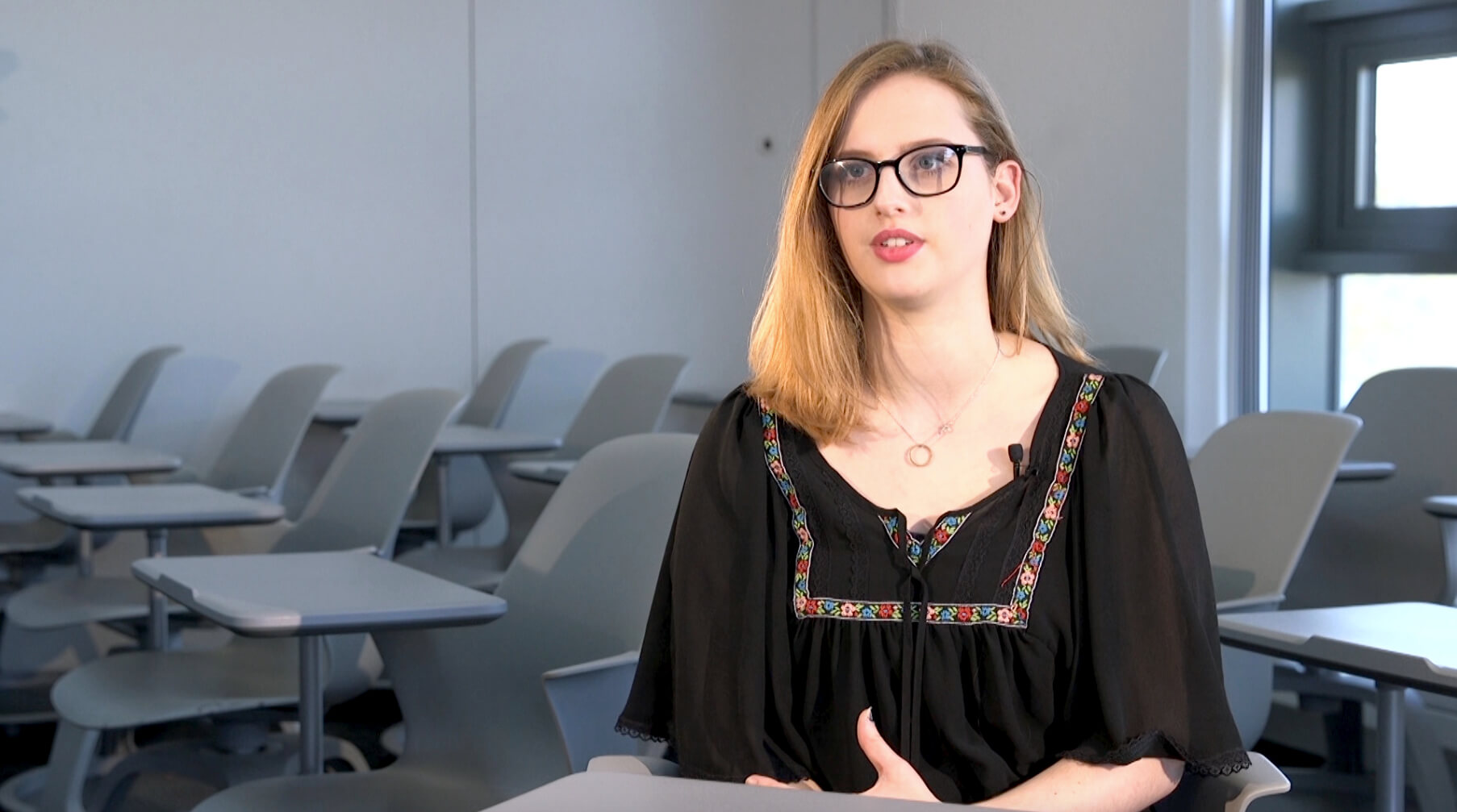
“Sociology helps me piece things together and see the world how it really is. The campus at Bath Spa is beautiful! It’s a really peaceful place to think and the lecturers are passionate about what they teach.”
Kirsty Taylor, Sociology student
Opportunities
As part of your degree, you could study abroad on a placement at one of Bath Spa’s partner universities.
The programme offers a range of opportunities that enable you to apply sociological knowledge beyond the classroom. Field trips, placements, and guest speakers are embedded throughout the curriculum, giving you insight into professional and community-based practice. You'll be able to engage with practitioners working in areas such as community arts and wellbeing, healthcare, youth support, and refugee and community services.
The programme has established links with external organisations, including Bristol Refugee Rights, Stand Against Racism and Inequality, schools and colleges, and local youth and community support services.
These partnerships support opportunities for volunteering, applied projects, placements, and community engagement and practice, helping you develop experience, confidence and employability.
You'll be well prepared for a wide range of roles across the public, voluntary, community, and private sectors. The degree develops strong analytical, research, communication, and problem-solving skills that are valued in roles such as policy and research support, community and youth work, health and wellbeing services, education and outreach, charity and NGO work, local government, equality and inclusion roles, media and communications and roles within the criminal justice and social care sectors.
You'll also progress into further study and professional training in areas such as social research, teaching, health and social care, public policy, and related postgraduate pathways. You'll develop strong analytical and research skills that are highly transferable across sectors. These include the ability to interpret data, evaluate evidence, understand audiences and behaviour, and communicate insights clearly - skills that are particularly valued in fields such as marketing, communications, human resources and organisational development.
If you’re a full-time undergraduate student starting your first year at Bath Spa University, you can apply for the Certificate in Global Citizenship, which you’ll study alongside your degree.
You’ll gain global awareness and add an international dimension to your student experience, and funding is available. On successful completion of the programme, you’ll be awarded a Certificate in Global Citizenship. This is in addition to your degree; it doesn’t change your degree title or results.
Professional placement year
The Professional Placement Year (PPY) provides you with the opportunity to identify, apply for, and secure professional experience, normally comprising one to three placements over a minimum of nine months. Successful completion of this module will demonstrate your ability to secure and sustain graduate-level employment.
By completing the module, you'll be entitled to the addition of 'with Professional Placement Year' to your degree title.
Before your PPY, you'll work to identify roles of interest and secure a placement. The Placements Team will support through timetabled sessions and 1:1 appointments.
As well as completing a minimum of 900 placement hours, you will complete two assessments demonstrating your skill development, growth in professional behaviours and how the PPY has impacted your future career aspirations.
Facilities and resources
Sociology is taught at Newton Park campus.
You'll have access to excellent facilities and resources such as:
You'll benefit from access to a supportive and well-resourced learning environment, including modern teaching spaces, digital learning platforms, and library resources that support sociological study, research, and applied learning. Online systems provide access to academic journals, datasets, and specialist resources used across the social sciences. You'll also have access to ASk.
Teaching is delivered by a research-active and practice-engaged academic team with expertise across social inequality, health and wellbeing, digital society, culture and media, governance and policy, community engagement, and social justice. Staff bring a wide range of disciplinary and professional perspectives into teaching, ensuring you engage with contemporary debates and real-world applications of Sociology.
You'll also benefit from guest speakers and practitioner expertise, with contributions from professionals working in community organisations, healthcare, education, youth and refugee support, and the voluntary sector. This combination of academic and practitioner expertise helps you connect sociological ideas to professional practice and future careers.
Our library gives you access to books, academic journals and DVDs and an extensive range of electronic services. It also provides a place for individual study and collaborative work.


Fees
| Student | Annual tuition fee |
|---|---|
| UK full time | £9,790 |
| UK part time | £4,895 |
| International full time | £18,330 |
Professional Placement Year
During the placement year, the fee is reduced to 20% of the full time fee. This applies to UK and EU/International students.
- UK: £1,955
- International: £3,666
International fee information
Our fees for international students are organised into bands. For more information, please consult the tables on the international student fees webpage.
Additional course costs
You may need to pay additional course costs over and above your tuition fees, for example, for specialist equipment or trips and visits. Please check the course Programme Document (linked under the main image on this page) for details of any additional costs. You can also read our Additional Course Costs Policy for further information.
Funding opportunities
Please visit our Funding pages for an overview of the funding options that may be available, including scholarships and bursaries.
Interested in applying?
This course is designed for students who care about the world around them and are motivated to understand - and respond to - complex social problems. Ideal applicants are curious, reflective, and open to having their assumptions challenged. They are often driven by a desire to make a difference, even if they are not yet sure how or where they want to do so.
The programme particularly suits students with a strong sense of social justice, an interest in inequality, community, culture, and social change, and a willingness to engage critically with difficult ideas and real-world issues. It is for those who want more than abstract theory alone, and who are looking for a degree that offers practical support, applied learning and opportunities to connect sociological insight to action.
You should be prepared to participate actively in discussion and debate, to reflect on your own position in the world, and to commit to developing your thinking over time. In return, the course supports you to better understand how society works before deciding how you want to contribute to it - equipping you with the insight, confidence and skills needed to move forward with purpose.
We accept a wide range of qualifications for entry to our undergraduate programmes. The main ones are listed below:
- A Level – grades BBB-BCC. No specific subject required.
- BTEC – Extended Diploma grades from Distinction Distinction Merit (DDM) to Distinction Merit Merit (DMM). No specific subject required.
- T Levels – grade Merit. No specific subject required.
- International Baccalaureate – a minimum of 32 points.
- Access to HE courses – Access to HE Diploma or Access to HE Certificate (60 credits, 45 of which must be Level 3, at Merit or higher). No specific subject required.
If you don’t meet the entry requirements above, we may be able to accept your prior learning or experience from outside of formal education. See our Accreditation of Prior Learning (APL) page to learn more.
English Language Requirements for International and EU Applicants
IELTS 6.0 - for visa nationals, with a minimum score of IELTS 5.5 in each element.
Course enquiries
For further information about the programme or entry requirements, please email us at admissions@bathspa.ac.uk.
Ready to apply? Click the 'apply now' button in the centre of this page.
Need more guidance? Head to our how to apply pages.
You're encouraged to take an interest in what is happening in the world around you and to reflect critically on how social issues are represented and discussed. This includes paying attention to current events, media coverage, and public debate, and considering questions such as whose voices are heard, how problems are framed, and what kinds of solutions are proposed.
To help you prepare, the course provides optional preparation materials designed to introduce sociological ways of thinking. These include short videos, podcasts, and accessible articles that explore key social problems such as inequality, racism, political polarisation, addiction, digital life, and the social impact of emerging technologies:
These resources are intended to get you thinking differently and questioning taken-for-granted assumptions, rather than requiring prior specialist knowledge.
There is no expectation that you'll arrive with prior knowledge of Sociology.
What matters most is curiosity, openness to new perspectives, and a willingness to reflect critically on the world you live in. The course is designed to support you in developing these skills from the outset.
Course leader: Dr Scott Kerpen
Email: s.kerpen@bathspa.ac.uk
Three year course
With placement year
- Award
- BA/BSc (Hons) Media Communications and Sociology
- School/s
- Bath School of Art, Film and Media, School of Sciences
- Campus or location
- Newton Park and Locksbrook Campus
- Course length
- Three years full time, or four years full time with professional placement year. Part time available.
- UCAS codes
- Institution Code: B20
- Course Code: PL93 or S150
- Campus Code: A,BSU
Entry requirements
We accept a wide range of qualifications for entry to our undergraduate programmes. The main ones are listed under 'Typical offers' in the main column below. For combined courses, please check both subjects. If your qualification is not listed, please email admissions@bathspa.ac.uk with your specific details.